Jun 2026
Joined Amazon in San Diego as an Applied Scientist II Intern, working on self-evolving multi-agent LLM systems for scam and phishing detection.
Ph.D. candidate in Computer Science, University of Missouri
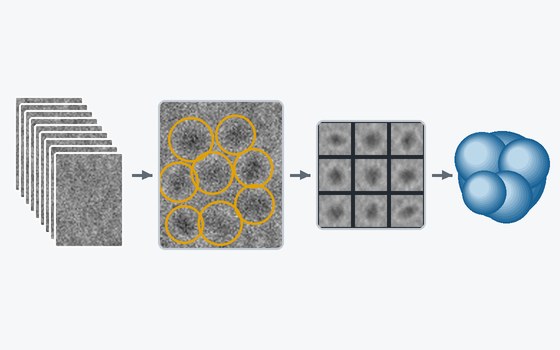
I develop machine learning methods for scientific data, where signals are faint and trustworthy labels are expensive. My research asks how to combine complementary sources of evidence, how to adapt pretrained foundation models to low-signal data, and how to learn when supervision is scarce or unreliable. Most of this work is in cryo-electron microscopy (cryo-EM), where these problems limit how quickly protein structures can be determined. I work in the Bioinformatics and Machine Learning Lab, advised by Dr. Jianlin Cheng.
I have built MICA, which combines cryo-EM maps with AlphaFold3 predictions to build atomic models of protein complexes; particle pickers built on foundation models; and CryoPPP and CryoVirusDB, expert-labeled benchmarks for particle picking, all with open code and data. As an Applied Scientist II Intern at Amazon in 2026, I built a training-free system in which LLM agents improve through adversarial self-play and detect real-world scam and phishing pages without retraining.
I expect to complete my Ph.D. in May 2027 and am on the job market.
My research follows four connected themes: multimodal learning and the adaptation of foundation models to low-signal scientific data; learning from scarce and unreliable supervision; benchmarks and evaluation that let a field measure its progress; and LLM agents that improve themselves without retraining. The projects below put each theme into practice, from atomic models of protein complexes to phishing detection.
MICA, Communications Chemistry, 2025
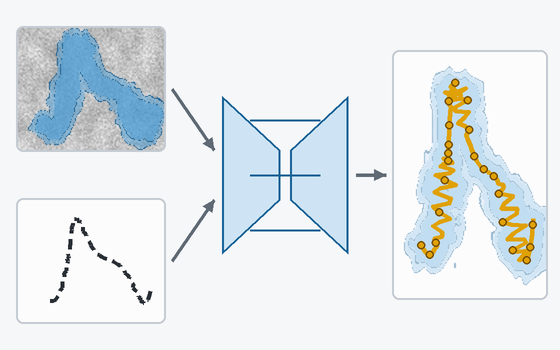
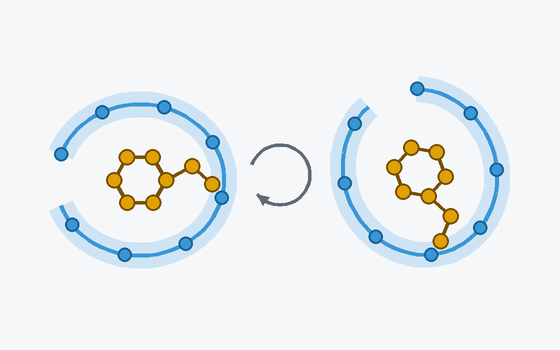
MICA fuses cryo-EM density maps with AlphaFold3 predictions in a multi-task encoder–decoder that predicts backbone atoms, Cα atoms, and amino acid types, then refines them into an atomic model of the protein complex.
MICA reaches an average TM-score of 0.93 on recently released high-resolution cryo-EM maps and significantly outperforms other state-of-the-art deep learning methods in accuracy and completeness, while staying robust to protein size and map resolution.
Applied Scientist II Intern, Amazon, 2026
In this training-free framework, an attacker agent synthesizes new phishing pages and URL attack patterns, an oracle certifies their labels, a detector classifies them, and a reflector distills reusable detection strategies, so the system improves through adversarial self-play.
The learned strategies transferred to real-world scam URLs and phishing pages without retraining, outperforming existing baselines on multiple public and internal benchmarks while keeping false-positive rates low.
CryoSegNet, CryoTransformer, CryoFSL, 2024–2026
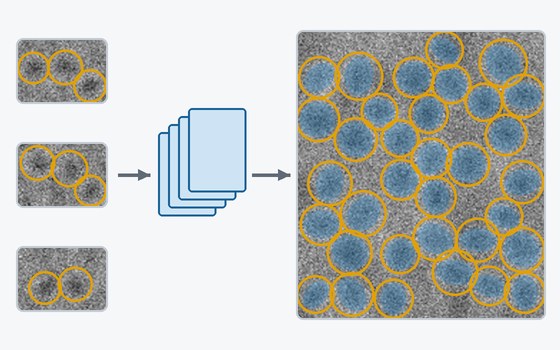
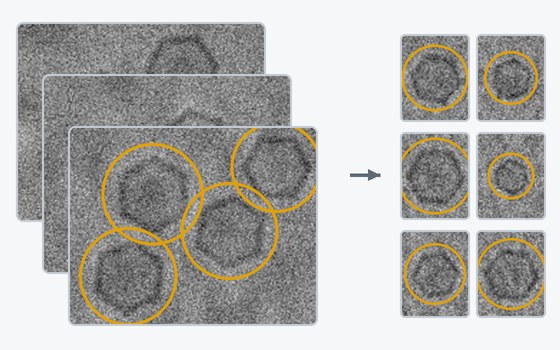
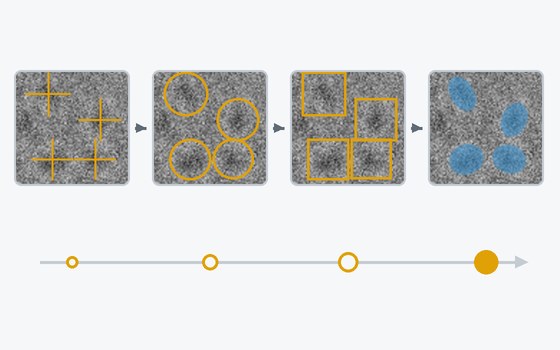
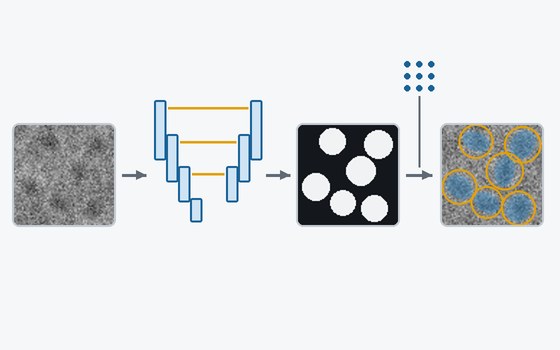
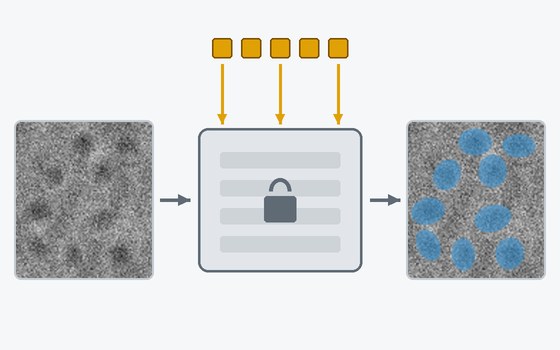
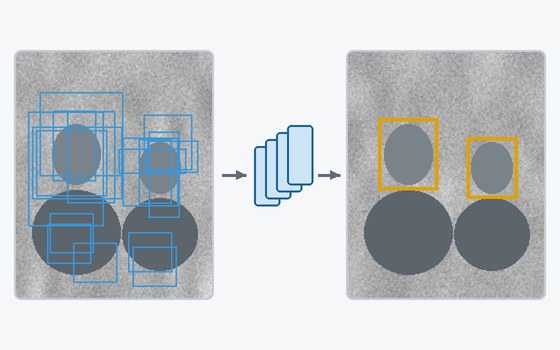
CryoSegNet couples Meta’s Segment Anything Model with an attention-gated U-Net, CryoTransformer uses a ResNet and transformer detector, and CryoFSL adapts foundation models with few-shot learning.
CryoSegNet surpasses the widely used pickers crYOLO and Topaz, CryoTransformer outperformed state-of-the-art methods as the first picker trained on CryoPPP, and CryoFSL picks robustly from only a handful of annotated micrographs.
CryoPPP, Scientific Data, 2023; CryoVirusDB, Viruses, 2026
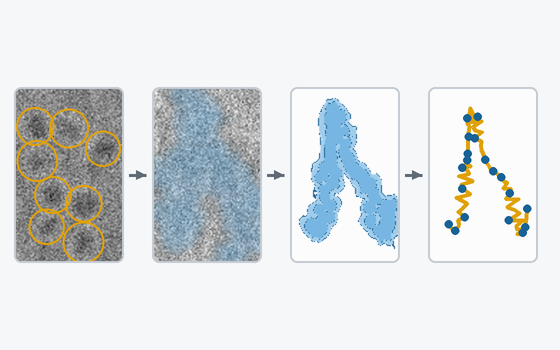
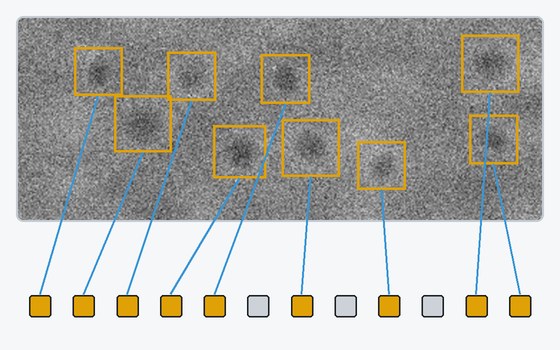
CryoPPP and CryoVirusDB are expert-curated datasets for training and testing particle pickers, with CryoPPP’s labels validated by 2D particle class validation and 3D density map validation against the gold standard.
CryoPPP contains 2.6 TB and 9,893 micrographs from 34 EMPIAR protein datasets, and CryoVirusDB adds 9,941 micrographs and 339,398 labeled virus particles from nine EMPIAR datasets.
* equal contribution
CryoFSL: a few-shot learning framework for robust protein particle picking in cryo-EM micrographs
Briefings in Bioinformatics, 27(3), bbag285, 2026
@article{poudel2026cryofsl,
  title   = {{CryoFSL}: a few-shot learning framework for robust protein particle picking in cryo-{EM} micrographs},
  author  = {Poudel, Biplab and Gyawali, Rajan and Dhakal, Ashwin and Cheng, Jianlin and Xu, D.},
  journal = {Briefings in Bioinformatics},
  volume  = {27},
  number  = {3},
  pages   = {bbag285},
  year    = {2026},
  doi     = {10.1093/bib/bbag285}
}
CryoVirusDB: An Annotated Dataset for AI-Based Virus Particle Identification in Cryo-EM Micrographs
Viruses, 18(2), 224, 2026
PaperCodeDataJournal article, dataset
@article{gyawali2026cryovirusdb,
  title   = {{CryoVirusDB}: An Annotated Dataset for {AI}-Based Virus Particle Identification in {Cryo-EM} Micrographs},
  author  = {Gyawali, Rajan and Dhakal, Ashwin and Wang, Liguo and Cheng, Jianlin},
  journal = {Viruses},
  volume  = {18},
  number  = {2},
  pages   = {224},
  year    = {2026},
  doi     = {10.3390/v18020224}
}
AI tools for cryo-EM: Protein particle picking, density map enhancement, and atomic model building
Progress in Molecular Biology and Translational Science, 223, 71–113, 2026
Book chapter
@incollection{dhakal2026aitools,
  title     = {{AI} tools for cryo-{EM}: Protein particle picking, density map enhancement, and atomic model building},
  author    = {Dhakal, Ashwin and Gyawali, Rajan and Selvaraj, J. and Cheng, Jianlin},
  booktitle = {Progress in Molecular Biology and Translational Science},
  volume    = {223},
  pages     = {71--113},
  publisher = {Academic Press},
  year      = {2026}
}Multimodal deep learning integration of cryo-EM and AlphaFold3 for high-accuracy protein structure determination
Communications Chemistry, 8(1), 320, 2025
@article{gyawali2025mica,
  title   = {Multimodal deep learning integration of cryo-{EM} and {AlphaFold3} for high-accuracy protein structure determination},
  author  = {Gyawali, Rajan and Dhakal, Ashwin and Cheng, Jianlin},
  journal = {Communications Chemistry},
  volume  = {8},
  number  = {1},
  pages   = {320},
  year    = {2025},
  doi     = {10.1038/s42004-025-01718-5}
}
Artificial intelligence in cryo-EM protein particle picking: recent advances and remaining challenges
Briefings in Bioinformatics, 26(1), bbaf011, 2025
PaperReview article
@article{dhakal2025review,
  title   = {Artificial intelligence in cryo-{EM} protein particle picking: recent advances and remaining challenges},
  author  = {Dhakal, Ashwin and Gyawali, Rajan and Wang, Liguo and Cheng, Jianlin},
  journal = {Briefings in Bioinformatics},
  volume  = {26},
  number  = {1},
  pages   = {bbaf011},
  year    = {2025},
  doi     = {10.1093/bib/bbaf011}
}CryoSegNet: accurate cryo-EM protein particle picking by integrating the foundational AI image segmentation model and attention-gated U-Net
Briefings in Bioinformatics, 25(4), bbae282, 2024
@article{gyawali2024cryosegnet,
  title   = {{CryoSegNet}: accurate cryo-{EM} protein particle picking by integrating the foundational {AI} image segmentation model and attention-gated {U-Net}},
  author  = {Gyawali, Rajan and Dhakal, Ashwin and Wang, Liguo and Cheng, Jianlin},
  journal = {Briefings in Bioinformatics},
  volume  = {25},
  number  = {4},
  pages   = {bbae282},
  year    = {2024},
  doi     = {10.1093/bib/bbae282}
}
CryoTransformer: a transformer model for picking protein particles from cryo-EM micrographs
Bioinformatics, 40(3), btae109, 2024
@article{dhakal2024cryotransformer,
  title   = {{CryoTransformer}: a transformer model for picking protein particles from cryo-{EM} micrographs},
  author  = {Dhakal, Ashwin and Gyawali, Rajan and Wang, Liguo and Cheng, Jianlin},
  journal = {Bioinformatics},
  volume  = {40},
  number  = {3},
  pages   = {btae109},
  year    = {2024},
  doi     = {10.1093/bioinformatics/btae109}
}
Adapting Segment Anything Model (SAM) through prompt-based learning for enhanced protein identification in cryo-EM micrographs
IEEE International Conference on Medical Artificial Intelligence (MedAI), 9–20, 2024
PaperConference paper
@inproceedings{he2024adapting,
  title     = {Adapting {Segment Anything Model} ({SAM}) through prompt-based learning for enhanced protein identification in cryo-{EM} micrographs},
  author    = {He, F. and Yang, Z. and Gao, M. and Poudel, B. and Dhas, N. S. E. S. and Gyawali, R. and Dhakal, A. and others},
  booktitle = {Proceedings of the IEEE International Conference on Medical Artificial Intelligence (MedAI)},
  pages     = {9--20},
  year      = {2024}
}A large expert-curated cryo-EM image dataset for machine learning protein particle picking
Scientific Data, 10(1), 392, 2023
PaperCodeDataJournal article, dataset
@article{dhakal2023cryoppp,
  title   = {A large expert-curated cryo-{EM} image dataset for machine learning protein particle picking},
  author  = {Dhakal, Ashwin and Gyawali, Rajan and Wang, Liguo and Cheng, Jianlin},
  journal = {Scientific Data},
  volume  = {10},
  number  = {1},
  pages   = {392},
  year    = {2023},
  doi     = {10.1038/s41597-023-02280-2}
}
Predicting protein–ligand binding structure using E(n) equivariant graph neural networks
bioRxiv, 2023.08.06.552202, 2023
PaperPreprint
@article{dhakal2023egnn,
  title   = {Predicting protein-ligand binding structure using {E(n)} equivariant graph neural networks},
  author  = {Dhakal, Ashwin and Gyawali, Rajan and Cheng, Jianlin},
  journal = {bioRxiv},
  pages   = {2023.08.06.552202},
  year    = {2023},
  doi     = {10.1101/2023.08.06.552202}
}An Approach for the Employee Face Recognition by RPN and Faster R-CNN Techniques
Proceedings of IOE Graduate Conference, 2019-Summer, 6, 231–237, 2019
PaperConference paper
@inproceedings{gyawali2019face,
  title     = {An Approach for the Employee Face Recognition by {RPN} and {Faster R-CNN} Techniques},
  author    = {Gyawali, Rajan and Pant, Dibakar Raj},
  booktitle = {Proceedings of IOE Graduate Conference, 2019-Summer},
  volume    = {6},
  pages     = {231--237},
  year      = {2019}
}Protein particle picking with the Segment Anything Model and an attention-gated U-Net, with output for RELION and CryoSPARC.
Particle picking with a ResNet and transformer detector trained on CryoPPP.
Amazon, San Diego, CA
Built a training-free, self-evolving framework for URL-based scam and phishing detection, driven by adversarial self-play among four LLM agents: an attacker that synthesizes novel phishing pages and URL attack patterns, an oracle that certifies ground-truth labels, a detector, and a reflector that distills reusable detection strategies. Strategies learned from synthetic attacks transferred to real-world scam URLs and phishing pages, outperforming existing baselines on public and internal benchmarks without retraining while keeping false-positive rates low.
Bioinformatics and Machine Learning Lab, University of Missouri, Columbia, MO
Deep learning for cryo-EM and protein structure: multimodal atomic model building (MICA), foundation-model-based particle picking (CryoSegNet), and benchmark datasets (CryoPPP, CryoVirusDB), plus contributions to transformer-based detection, few-shot learning, macromolecule identification in cryo-ET tomograms, and protein–ligand binding prediction with E(n)-equivariant graph neural networks. Trains models with PyTorch DDP on multi-node, multi-GPU clusters (Slurm, LSF).
Nepal Telecom, Kathmandu, Nepal
Built the Wireless KPI Analytics Tool, a Django application with REST APIs that automated analysis across 5,000+ network elements and cut analysis time from days to minutes. Designed Python and SQL pipelines for 10+ GB of daily network data, and LSTM models for anomaly detection and forecasting that improved network reliability by 15%.
Himalaya College of Engineering, Tribhuvan University, Kathmandu, Nepal
Promoted from Assistant Lecturer to Lecturer within a year, then continued as Adjunct Lecturer alongside full-time engineering work. See Teaching and mentoring.
Bioinformatics and Machine Learning Lab, University of Missouri
Mentors undergraduate researchers in deep learning–based image segmentation.
Himalaya College of Engineering, Tribhuvan University, Kathmandu, Nepal
Instructor of record for undergraduate engineering courses, with 36–48 students each. Designed Python training and supervised final-year projects.
University of Missouri, Columbia, MO
Advisor: Dr. Jianlin Cheng. Focus: deep learning, computational biology and bioinformatics. GPA 4.0. Expected May 2027.
Tribhuvan University, Kathmandu, Nepal
Specialization in information and communication, graduated with distinction. Thesis: employee face recognition with region proposal networks and Faster R-CNN, 96.0% accuracy on the ChokePoint dataset.
Himalaya College of Engineering, Tribhuvan University, Kathmandu, Nepal
Graduated with distinction. Final project: a brain-controlled wheelchair using a NeuroSky MindWave brain–computer interface.